
Big Tech Seizes the Commanding Heights
What's it called again when giant corporations and a nationalist movement take power and install a police state?

I’ve written quite a bit on this publication about America’s More is Less dystopia, and how the expansion and diversification of the information age economy has actually reduced options and worsened outcomes for the ordinary citizen.
One facet of this is rising wealth inequality, which limits the ability of most people to take advantage of the opportunity in such an expanded and diversified marketplace.

I mean, what good is innovation (or “disruption” as the investor class like to call it) in the economy, and the development of all kinds of new goods and services, if people can barely afford necessities such as housing and healthcare? Or even gas and groceries?
Another facet of the More is Less economy is the way the digital space has evolved from an exciting frontier that rewarded individual creativity, into a boring, standardized, consolidated echo chamber of banal and useless information, dominated by a few big platforms.
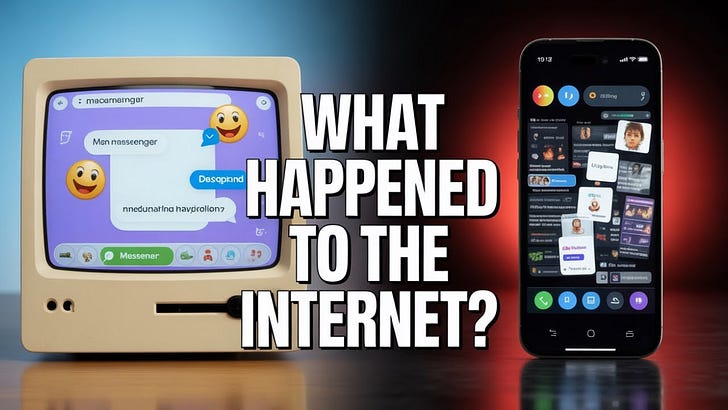
Those of us from the older generations remember the progress of the global information network we call the Internet. It began as research projects in government and academia. At the end of the 20th century, as the personal computer revolutionized both work and domestic life, it went commercial. Cyberpunk still referred to the promise of what it might become as “cyberspace” or the “matrix” in mostly off-the-mark speculative fiction, even as early adopters of the Internet sat through screeching modems and painfully slow media downloads.
As the next century dawned, data bandwidths improved. So did adoption, particularly with the invention of the “smartphone” - essentially a pocket computer with capabilities that surpassed that of yesteryear’s room-sized “mainframes.” Older media formats - the printed page, broadcast television - were in danger of being overwhelmed by the “convergence” of consumer channels online. Today, we accept the new normal of getting our news from social media and news aggregators, and watching our video entertainment on a plethora of streaming platforms, all accessible on our little black mirrors.
In a predictable pattern, repeating that of past technological revolutions, the Internet marketplace transitioned from a chaotic free-for-all into a structured and streamlined environment controlled by a few monopolistic corporations. Those of us (meaning us Generation Xers) at the head of these enterprises emerged as a new corporate elite, the Big Tech Bosses in charge of our way of life.

In what might also be a predictable pattern for Generation X, these oligarchs aren’t exactly popular. They just don’t enjoy the same glowing prestige as the old Boomer Godfathers of the high-tech age, such as Bill Gates and Steve Jobs. As culture historian Ted Gioia has observed:
Not long ago we looked to Silicon Valley as the place where dreams came from, but now it feels more like ground zero for the next dystopian nightmare.
Gee, what went wrong?
In the late 1990s, two economists wrote a book called The Commanding Heights, in which they traced the rise of the globalized free market regime then replacing the previous Keynesian order, where government had regulated the economy with a heavier hand. The transition was the outcome of the Reagan revolution, with its attitude, expressed by Ronald Reagan in his first inaugural address, that “government is the problem.” The “commanding heights” was a phrase borrowed from Vladimir Lenin, referring to key sectors of the economy, and control over these was now shifting from the public sector to the private sector.1
When you read posts about these dystopian times2, you get the impression that the private sector - at least in the form of the billionaire oligarchs running the major tech companies - has completely taken over the “commanding heights”. Their latest and greatest disruptive technology is, of course, the advanced machine learning algorithms that generally go by the name “AI,” and that gobble up vast amounts of both data and energy, and consequently money. I have even read the claim that this activity is all that is currently propping up the US economy.
There’s a lot analysis about AI out there that claims that it is destined to be the new system or strategic space that defines the Novus Ordo Seclorum. As it becomes all-pervasive, AI will replace state sovereignty, and the tech oligarchs will become Overlords in a new kind of digital feudalism. So the thinking goes, as far as I can tell.
These analyses are overblown, in my opinion, though one can understand how it would be easy to be in awe of AI. Anyone who uses the Internet can see that it has become embedded in everyday software, as its output is there in our faces all day. And the headlines make it clear that it is being used more and more in both the military and law enforcement. Machines are making life and death decisions, just like the murderbots in the grim sci-fi stories.
It’s not specific advancements in information technology that should worry us, it’s the purpose to which they are being employed. As always, the technology is not inherently good or evil - it’s a tool and it’s the humans using it that bear moral responsibility.
Ultimately it is human choice that matters the most. It was human choice that gave us the dreadful decision in the United States Supreme Court case Citizens United v. Federal Election Commission, which opened the floodgates to “dark money” pouring into election campaigns, tilting elections in favor of wealthy interests. As if they weren’t already unbalanced enough. This was arguably the pivot point that secured the oligarchy’s power grab.
A report by the Roosevelt Institute did a great job of exposing just how much more money has been spent on elections since that 2010 decision, and how much this has helped the Republican party. It took us to the point that, in the last Presidential election, the wealthiest man in human history was able to buy himself an extra-Constitutional government office and use it to ransack the federal bureaucracy.
The DOGE destruction, and the way the Big Tech CEOs lined up to kiss the ring at the inauguration, made it possible to think of 2024 as the year of the billionaire coup. A tiny number of people at the top of the economic pyramid had completely taken over, and of course would then do everything in their power to make themselves even wealthier, at the expense of the common man.
But is this really a case of the private sector finally asserting full control over society? Consider that millions of US voters made the choice of voting for this. The government, representing the will of those people, is asserting itself powerfully, just doing so in ways that are counter to the values of the millions who voted otherwise. Really, the public sector has been taken over by the political right, and the top leaders in the private sector, more interested in money than anything else, are playing along. The right-wing model, after all, imposes a social hierarchy that allows them retain their privilege.
There’s a term for an authoritarian, anti-democractic government that has a militaristic agenda, seeks to purify the national culture by removing unwanted people and ideas, and enlists corporate power toward that purpose. It starts with an “F” and supposedly gets overused in political discourse. But hey, it if walks like a duck and it quacks like a duck…you know what I mean?
The real battle for the commanding heights is the political struggle to determine whether government serves the people, or only the elites. Another often repeated pattern in American history. While we still have our democracy, we the people have a chance to seize them back.
It’s possible I’ve oversimplified the authors’ thesis, and that’s on me. You can read the book yourself if you want the full picture: Yergin, Daniel., Stanislaw, Joseph. The Commanding Heights: The Battle for the World Economy. United States: Simon & Schuster, 1998 (ISBN 9780684829753).
That’s at least half of my feed here on Substack, lol.