
Thinking along the Generational Diagonal
How this helps us to understand our social era

Here on Darkest Hour, I’ve often referenced a particular theory of generational cycles. It’s the one conceived by William Strauss and Neil Howe, which you might know from the book The Fourth Turning1, probably the best known of their works. William Strauss is no longer with us, but Neil Howe is still writing on the topic, and in fact is publishing regularly right here on Substack.
While I like historical cycle theories a lot, I didn’t want to make Darkest Hour specifically about cycles. It’s more about how we are in dark times, and it’s difficult to get our bearings or see where we are going, but here are some insights that might help make sense of it. To that end, cycle theories can shed some light, so they are bound to come up in my writing.
This specific article is about a way of thinking about generations that is used in the Strauss-Howe model, and that could be one of those insights that helps shed some light. I like to call it “thinking along the generational diagonal.” Here’s a diagram I made that helps explain it, if you’ll forgive my crudely drawn arrow.
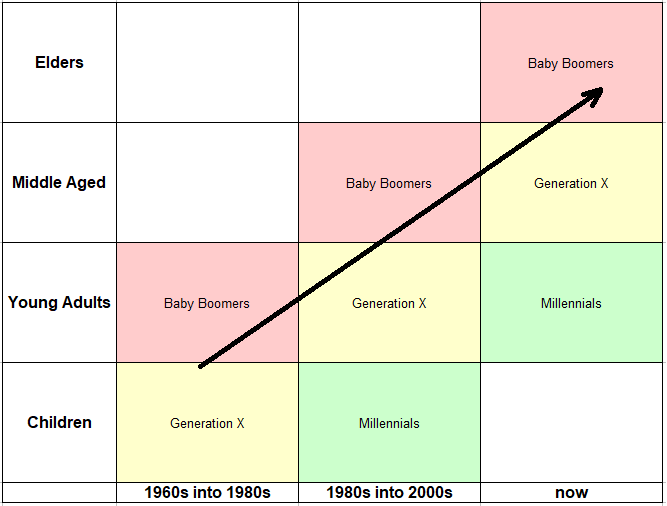
The vertical axis there is age brackets, roughly 20 years in length. So young adult means twentysomethings and thirtysomethings. Forties and fifties makes you middle aged, and sixty plus is the old folks. The horizontal axis is historical time, chopped up into different eras, also roughly 20 years in length.
The labeled and colored blocks are the generations: all the people born in a particular era. My generation, Generation X, was born during the culturally revolutionary era of the 1960s into the 1980s - we were children then. The Baby Boomers, born earlier, were the young adults of the same time period. So people in those two generations experienced that era from different perspectives, based on their age bracket.
For young adult Baby Boomers, it was a liberating time of experimentation, when everything felt wide open and anything was possible. For us Gen X latchkey kids, it was a time when our parents raised us hands-off, often to the point of utter neglect, and we learned to fend for ourselves.
Based on these shared historical experiences by age bracket, the members of a generation develop certain shared characteristics. The key insight of the generational diagonal is that, as time passes, each generation ages into a new bracket, replacing the generation that came before it, and bringing its characteristics to a new phase of life.
So, for example, the young adults of the 1980s era were more like the children of the earlier era than they were like the young adults of the earlier era. Make sense?
If you were alive then, you might remember that in the 1980s into the 1990s, there was talk of how the young people had changed. They had lost the idealism of the 1960s. All they cared about was money and getting ahead. It wasn’t so much that the young people had changed, as that a new group of people were now “the young people.”
This change was generally portrayed as a negative development2, but it was really a logical outcome of first raising a batch of kids neglectfully, then tossing them into a newly deregulated market economy that had been energized by a cultural revolution. We weren’t purely materialistic so much as focused on the bottom line and survival, as we tried to make our way in a new social order, so much unlike what recent generations before us had experienced.
Fast forward to now, and my generation isn’t the young one any more. We’ve been replaced in the young adult age bracket by Millennials, and I’m sure you’ve heard all the whining about how they are different than we were growing up. They’re entitled. They won’t take the risks and make the sacrifices needed to strike out on their own. They just don’t have that survivalist mentality!
But take a look at that diagram. It should make it clear why this isn’t a surprise. How could a cohort of young people who were raised starting in the 1980s, in a more protective environment than Generation X was raised in, now trying to make their way in today’s punishing new social order, have ended up like Generation X?
Do you see how the diagonal works?
My generation is now middle aged. We’re at the peak of our careers, in key leadership positions in government (example: Russell Vought) and business (example: Jeff Bezos). Consider the implications when you think along the diagonal. This same group of people who are survivalists, more focused on the bottom line than expansive ideals, are now the ones in charge.
Think of the slogans linked to my generation when we were young. “No Fear.” “Just Do It.” We were associated with risk-taking and extreme behavior. And now we’re running the show. No wonder everything’s turned upside down, and the rules don’t matter any more!
And what about the Baby Boomers? Well, when they were young back in the 1960s, they were the original disruptors, who challenged “the establishment.” They were the counterculture rebels, and also the reactionaries who opposed the counterculture. In middle age, their moralizing fomented the “Culture Wars”3 that are still being fought today.
Now they’re the old folks, and while the young generation might make fun of them for being out of touch, Boomers sit squarely on top of the very institutions they challenged in their youth. They have become the establishment, while retaining the same appetite for destruction they have had since the 1960s. Doesn’t that help explain the behavior of the Boomer-in-chief who is in command right now?
In their generational theory, Strauss and Howe call the arrangement of generations by age bracket the “generational constellation” of a social era. It’s a concept I’ve brought up on this publication before.

Within a social era, the characteristics of the generations in each age bracket contribute to defining the priorities of the time, as well as the overall social mood. What is called the zeitgeist, or spirit of the age. In current parlance, the “vibe.”
In today’s era, we have a generation of elders who are completely certain of the moral correctness of their viewpoint, and a generation of mid-lifers who are prone to rule-breaking and not particularly sensitive to what anyone thinks about it.4 That helps to explain why there is so much ongoing destruction of our institutions, amidst a struggle to determine how they should be rebuilt. It helps to explain the darkness of our time, the hardness to the social mood, and the compelling sense of emergency.
We didn’t have much choice about getting to this stage of history. The march along the generational diagonal is inexorable, because no one can alter either 1) the generation into which they are born or 2) the fact that they will grow older with time.
If it helps to know, the march will continue. The generations will all get older, and the social mood will eventually shift again, when the constellation changes and we enter yet another new social era.
Meanwhile, I plan more posts in the coming weeks that leverage the power of the generational diagonal to explain, for each of today’s living generations, where they are and how they got there.
Strauss, William and Howe, Neil. The Fourth Turning: An American Prophecy. New York: Broadway Books, 1997 (ISBN 9780767900461).
One book lambasted us for having dull, lazy minds and lacking critical thinking skills: Bloom, Allan. The Closing of the American Mind. United States: Simon & Schuster, 1987 (ISBN 9780671479909).
For a report from the ground at the time, see: Hunter, James Davison. Culture Wars: The Struggle to Define America. United States: Basic Books, 1991 (ISBN9780465015344).
Generation X is “all out of fucks to give” is how you may have heard it put.
Keep digging into what Howe wrote in his 2023 book about Ekpyrosis and when generational archetypes activate. Also, each generation has voters who want society the way they remember and voters who want society to change. Howe writes on page 306 "near the climax off a Crisis-era, norms shift further still -- and in the opposite direction...." from the past. Howe refers to Rip Van Winkle as analogy. post-crisis climax we will wake up with a new social contract as if we had been asleep for 20 years. Keep writing.