
Back to the Future Part II
America yearns for a sequel to greatness

In a previous post, I introduced a slogan for our new dystopian age.

The slogan evoked a simple idea: that the only way forward out of dystopia that we can imagine is to return, somehow, to the past.

It’s understandable; after all, we can’t know the future, and the past is our only guide to how history moves, and how it might move again. So this may not be a particularly profound observation. But I still thought it would be interesting to take a look the ways our current timeline appears to be headed back to previous eras in my nation’s1 brief history.
First, let’s look at the international front.
The End of the End of History
There was this famous book about how the U.S. victory in the Cold War marked the end of history.2 Liberal democratic free-market capitalism had firmly established itself as the only system for organizing human affairs that made any sense. Western Civilization for the win! All that was left to do was finish reformatting the globe into a neoliberal free trade utopia.
I may be overstating the argument. My real point is that there was a period there when it was possible to view the geopolitical order as a benevolent American hegemony. The U.S. had lived up to its Cold War promise to be the superpower champion of capitalism against the sinister threat of communism, and as the last superpower standing would keep the global peace while the “developing world” continued to build up its own capitalist economies and join the free trade empire.3
As the 21st century unfolded, events overtook this happy viewpoint. 9/11, the War on Terror, the Iraq War that dragged on and on, then the Global Financial Crisis, Russia’s hybrid war against the West, the rise of Trumpism and Brexitism - history reasserted itself pretty hard. In response, every post-Bush President has rolled back U.S. engagement in world affairs, and we have gradually abdicated our hegemonic role, even while remaining the wealthiest and most militarily powerful nation on Earth.
The Trump 2.0 regime has gone all in on this strategic trend, abandoning long-standing alliances and openly aligning with our former Cold War enemy (Putin’s puppet, we say). Militarily, it has pivoted away from the Old World altogether and made the new focus border security and establishing dominance in the New World, international law be damned. It certainly makes sense to call this a return to the 200-year old Monroe doctrine.4
Leaving aside the ham-handedness of the administration’s strategy, and the illegality of its actions, this massive turn from the East to the West marks the end of what has been called the liberal postwar order maintained by American power. It’s also a clear sign that we are no longer in a “postwar” era. I’ve discussed already what that postwar order was:
At the start of the Cold War conflict with the Soviet Union, the United States was able to craft a unique postwar order via the Bretton Woods free trade agreements. These were essentially a pact between the U.S. and its Cold War allies: we will protect you from the Commies, and you will participate in our free trade regime, which includes access to our markets. The U.S. was able to do this because it had the only big navy left on the oceans (so it could protect the trade routes), and because it had such a huge economy relative to the rest of the world that it could easily prosper in a non-protectionist, open global market.
We’re so over that now, right? As the Dear Leader would put it, they’ve been taking advantage of us ever since, and it’s time to get tough and make some fantastic trade deals that aren’t so unfair to us. The administration has gone so far as to escalate the use of tariffs, in a throwback to the 1930s trade wars that collapsed that era’s version of globalization. It’s supposed to help our economy recover its manufacturing base…I guess…though it looks more like simple extortion, a concept I’m sure Trump can easily wrap his mind around.
This is where I see the return to the past: we’ve transitioned at last from the Cold War superpower era, back to a multipolar era where the U.S. is just one of numerous Great Powers, and doing it’s darnedest to stay out of European affairs (tough luck, Ukraine). The Trump administration’s America First strategy hearkens back to an earlier, isolationist stage of our history, when we were still an up and coming power, and had not yet eclipsed older European states.
And I don’t see how we undo all that has been done so far, given that we have badly damaged our relationships with the allies of what was once known as the “Western Bloc.”
Now on to the domestic front.
What It Means to Be an American
I’ve previously covered how there have been periodic revolutionary transformations of the American state.

As part of this transformation, the definition of who gets to be counted as an “American” has always expanded to encompass a more diverse set of people.5
American Revolution - a newly independent nation declares “all men” to be created equal, but of course we know they really mean all Anglo-Saxon men. American = former Englishman.
Civil War I - now we’ve accepted everyone from Northern Europe as being American. Yes, even the Irish. Technically, also the formerly enslaved African-Americans, but we look the other way while the South abuses this notion.
The New Deal - give us your tired, poor, huddled masses! Southern and Eastern Europeans now count as Americans, even Catholics and Jews! Who knows, maybe a Catholic could be President some day.6
The DEI Future We All Desire - we finally live up to the American Dream as fully as possible. All people, no matter their race, creed, national origin, gender or sexual orientation, count as American, so long as they were either born here or checked off all the right boxes on their immigration paperwork.
Ok, that last one is, um, aspirational. Clearly it is not the agenda of the current MAGA administration, which defines American Greatness as a strictly White and Christian phenomenon. To them, DEI is a sin, since it denies this ideal. This is where I see us really looking back to the past for a definition of what our future should be.
Boomers like Trump recall the Golden Age of the 1950s - when America was unabashedly racist and sexist, gays dared not show themselves, and Christainity was dominant - as the state to which we should return. This means erasing all the gains of the Civil Rights era, and reverting I suppose to the definition of “American” that we had around the New Deal era, although with Trump’s specially groomed Supreme Court set to reinterpret the 14th Amendment, who knows how far back we’ll go.
The MAGA movement might accept the pan-European origin definition of an American from the 1950s, but it rejects the strong labor unions and progressive tax structure that also define that era and helped to give it a strong middle class. In that regard, it’s like it wants to go back even farther, to before the Progressive Era of the late 19th and early 20th centuries, and to reinstate the Gilded Age.

Path to the Future
In my mind, what most sets MAGA apart from the woke opposition is its “America is for the Americans” rejection of the expansion of inclusiveness that came out of the Civil Rights movement. The money its sunk into ICE, measures to impede immigration (like $100,000 fees for H1B Visas), and the very framing of immigration as “invasion” amount to an ethnic cleansing project to purify the country.
It’s a pathetic project and, to me, extremely unAmerican. We should be aspiring to live up to the dream famously expressed by Martin Luther King, Jr., of living in an America that ignores outer differences and recognizes the humanity at the core of everyone.
It’s also an impossible project. The demographic trends are unstoppable. They are baked in for generations to come.
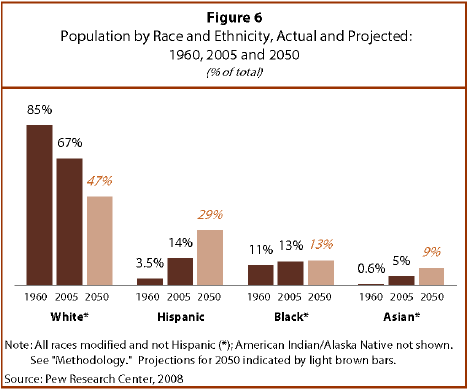
White America’s supremacy is coming to an end, albeit with a colossally destructive temper tantrum.
Finally accepting this is a necessary step toward truly becoming great again.
My nation being the United States of America.
Fukuyama, Francis. The End of History and the Last Man. United Kingdom: Penguin Adult, 1992 (ISBN 9780140134551).
Geo-strategist Thomas P. M. Barnett envisioned a framework for understanding the U.S. strategic mission post-Cold War to be to integrate the underdeveloped “Gap” nations with the rest of the gloablized “Core” nations. See: Barnett, Thomas P. M.. The Pentagon’s New Map: War and Peace in the Twenty-First Century. New York: G.P. Putnam’s Sons, 2004 (ISBN 9780399151750).
Thomas P. M. Barnett has reframed our strategic imperative as shifting to a North-South mode of integration and acknowledged that the Trump administration, however clumsily, is moving in that logical direction. See: The geographic “verticalization” of US combatant commands? Finally?. He’s also written a great critique of the new National Security Strategy: Trump’s strangely confessional National Security Strategy. He’s here on Substack and worth a subscription.
As covered in this excellent book: Lind, Michael, The Next American Nation: The New Nationalism and the Fourth American Revolution. United Kingdom: Free Press, 2010 (ISBN 9781451603095).
We’ve had two Catholic Presidents so far, John F. Kennedy and Joe Biden. The rest have been Protestants. Progress!