
The Pentagon's New Job
The military's demotion and the shame of its new role

I remember back in 1991, after Desert Storm, I was hanging out in a bar in my college town1, and I saw this guy in a T-shirt. The guy was a typical obnoxious frat boy. The shirt had a picture of an American soldier, a big white man, yelling and pointing a rifle in the face of a much smaller and terrified Arab soldier holding a tattered white flag. It was captioned: “WHOSE OIL IS IT NOW?”
I know I saw this, and I wish I could find an image to share here, but despite searching for vintage Desert Storm T-shirts (and there are plenty out there), I could not find this particular one.
Of course, the answer to the question on the shirt is: “IT’S KUWAIT’S OIL.” The early 1990s Gulf War was a rare case of a military invasion that was approved by the U.N. Security Council. It was signatories of the U.N. Charter banding together to help a fellow U.N. member whose sovereignty had been violated. It was following the “international rules-based order” which the United States had had a large hand in implementing after the hell of World War II.
But this guy in the bar instinctively saw the Gulf War as the United States flexing its military muscle to take some oil, that most valuable of resources in this Petroleum Age.2 The movement towards green energy notwithstanding, oil remains an essential component of modern civilization.
That guy was in college in 1991, and if he is alive today would be in his fifties, and probably a core MAGA Trump supporter. I’m guessing he would be OK with Trump’s current Venezuela policy, which is to point a rifle at the country and demand its oil.
It was always possible during the long years of the “Pax Americana” to believe that miltary interventions by the United States, such as the Iraq War in the early 2000s, were resource grabs in disguise.
We went through the motions of legitimizing our actions as necessary for a greater cause (they have WMDs, we swear!) and touted our commitment to democracy and freedom, which we were bringing to these benighted regions so that they could hook up their economies to the rest of the world. And sure, that meant we got access to their oil - you know, as a side benefit.
But that benefit, not the stated idealistic cause, was the real motivation, according to a cyncial view of American foreign policy.
Now, as I wrote earlier this week, we now have a one-party dictatorship, or are close to that state, and have abandoned the international rules-based order.
Welcome to the New World Order, Everyone!

I started Darkest Hour in the summer of 2025. I had already been posting doomy social commentary stuff on my blog, In the Zeitgeist, for a long time. But this site seemed like a more suitable place for that type of content, so I moved it off the blog and over to here. There are so many smart people doom posting on Substack! My blog is still up, but for …
Hence the administration feels unconstrained by the need to make justifications. Of course it’s always been about the oil. Why pretend any more? Cynics rejoice - you were right all along!
There was a recent interview with deputy President Stephen Miller on CNN which is worth watching, even though it’s a bit grating to listen to him and interviewer Jake Tapper talk over each other. Miller articulates the reasoning behind the administration’s America(s) First pivot toward the Western Hemisphere. The idea is that efforts to nation-build and spread democracy across the world were futile, the hopeless fantasy of neoliberalism. What we should be doing is dominating our region of the globe, as is our right as a superpower.
It’s a direct assertion that our right comes from our military superiority. As Miller says about 10 minutes in, “you can talk all you want about international niceties…but we live in a world…that is governed by strength, that is governed by force, that is governed by power.” This is simply embracing the principle of “might makes right,” which is grounded in stark material reality, but is also amoral and the reason we strive as a species to do better by crafting international law.
When Trump rejects “forever wars” and “nation-building” he means the costly quagmires that don’t directly profit the United States. But he doesn’t mean giving up on war; he clearly is gung-ho for that with how he renamed the Department of Defense and with his budgetary demands for more military spending.
There is this term “gunboat diplomacy” that refers to using naval power - the best kind of military power3 - as a coercive tool of foreign policy. The term was particularly apt from the 19th century to the turn of the 20th century. For example, President Teddy Roosevelt was a practitioner, characterizing the navy as a “Big Stick” to help ensure he got his way.
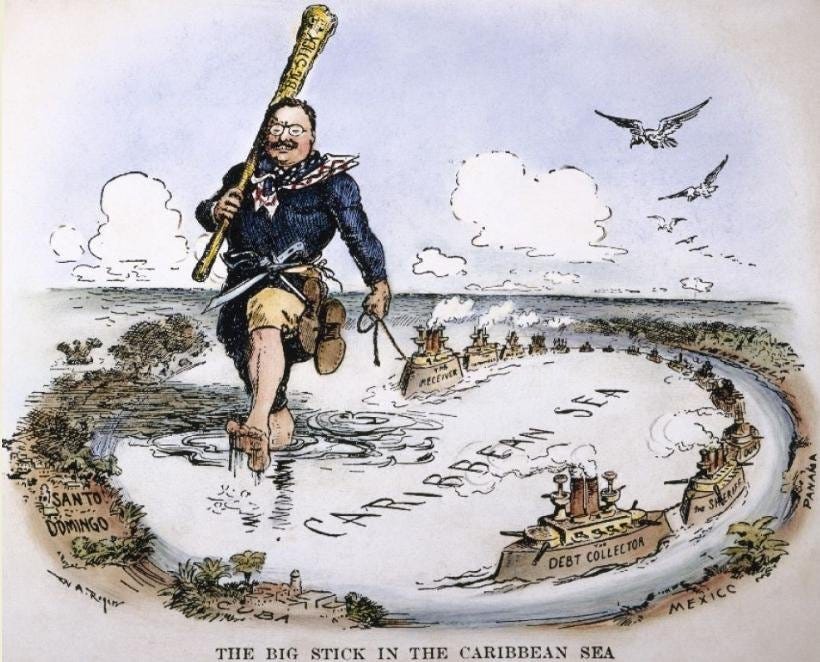
Arguably, Trump is practicing more of the same. In fact, Operation Southern Spear, the ongoing Caribbean rampage, is in Wikipedia’s list of examples of gunboat diplomacy.
But unlike Trump playing bad cop, Roosevelt was closer to playing good cop, aiming his guns at the European colonial powers. It was his corollary to the Monroe doctrine.
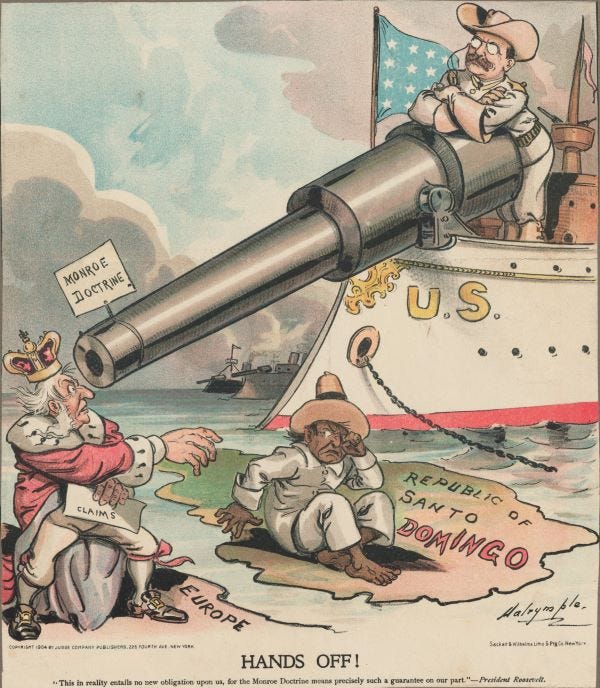
To understand what Trump is up to, let’s do a quick survey of how military power has been exercised over the centuries, vis-à-vis the mandate of the state.
A Brief History of Warfare
In the Middle Ages, Kings were often warriors. They were expected to go out and fight for their people, in a kind of role reversal for how it works in the modern nation-state. When English King Edward III invaded France in the Hundred Years’ War, even though he did state a claim to the French throne as a cause, he didn’t really intend to conquer France. He was simply going on a looting spree, and bringing the booty home to his own kingdom. And the English people loved him for it!4
Simply predating on one’s neighbors, if you were stronger than them, was the norm in that time period. When the predator people were particularly ferocious compared to the prey people, as in the Viking Age, it was really bad to be on receiving end of Medieval warfare.
As the modern state emerged after the Renaissance, war became much more costly and complicated. War went from the sport of Kings to a serious, scientific occupation; the King stayed at home and let the professionals do the work.5 At the same time, as market capitalism developed, the subjects of the state demanded and acquired more freedoms and political power.
After a lot of upheaval and some very messy wars, an understanding of the state as a political entity responsible for governing a particular territory and the people living within it was established. Previous power structures that had existed in the Middle Ages were invalidated. This arrangement is called “the Westphalian system” after a treaty from 1648, the Peace of Westphalia.
The treaty at Westphalia didn’t end war - nothing has historically. But it defined a concept of the state as having borders which other states shouldn’t violate, within which its laws applied. Sounds obvious to us centuries after this arrangement, but it’s not how people lived under feudalism in the Middle Ages. Whether these rules were respected or not determined the difference between a state of peace and a state of war.
In the early modern age, characterized by colonial expansion of European states, wars were territorial. Empires formed. The industrial revolution led to massive and extremely lethal military machines manned by huge populations, and war became ideological. In this deadliest era of wars, casualties were measured in the millions and the stakes were living or not living with slavery, genocide, and totalitarianism.
The end of World War II brought a new Peace which, so far, has not been broken on a global scale. The dream, instituted first in the aborted League of Nations and then with the founding of the United Nations in 1945 was, if not to end war, to at least provide a framework within which to manage it, be defining the extent, rights and obligations of the nations of the Earth.
The Westphalian system, a European creation, had been spread around the globe. It was spread by the bout of European colonialism in the 18th and 19th centuries that was then followed by waves of independence declarations, after the American example set in 1776 and then the collapse of European empires because of the World Wars. The system underlies today’s global political order and the United Nations Charter6.
With the passage of time, the generations that existed when the United Nations was founded have passed on. New generations have aged into leadership, and it appears that the current MAGA leaders of the United States have decided to abandon its charter, as Russia already has.
War - What Is it Good for?
So what’s next? Does the Westphalian system hold?
The Trump administration’s threats to annex territory in North America that is within the borders of other sovereign states suggests a return to wars of conquest. It’s naked oil grab in Venezuela suggests a return to the feudal ethos of rapine and plunder. He does call himself King, after all - and wow, that’s a lot of history of the evolution of civilization to erase.
But oil can’t be piled up on the baggage train of a marauding army and carried home, as plunder was in the time of King Edward III. The profit in it requires infrastructure, both physical and financial. Really, Trump wants to secure that profit for his cronies, and sees the U.S. military as a useful tool to that end, and certainly doesn’t believe he should restrain himself in how he uses it.
I found this thread here on Substack that explains the cold logic of the oil grab. It purports to be passing no moral judgment and taking no political side, and I think it’s worth a read even though a lot of it is technical jargon from the energy industry.

The jist of it is that the substantial oil reserves in Venezuela are particularly well suited to the Gulf Coast refineries, which are a huge sunk cost for American oil companies and are thirsty for raw product to consume. The reserves are suited both because of their proximity across a sea and because of the physical characteristics of the oil. There’s a kind of inexorable force that is pulling Venezuela’s oil in the direction of the Gulf Coast refineries.
A saner U.S. President might have tried to open up that oil flow by legal means, but not the one we’ve got. Remember, he runs his administration like a mob boss. He only understands how to get what he wants through intimidation and threats.
Welcome Back to the Mafia State!

Back during Trump 1.0 (I can’t believe we call it that now), I was still posting on that other site that went over to the dark side. If my memory hole serves, posts were called “tweets” over there. I remember “tweeting” this:
The Maduro takedown was quite simply a mob enforcement action, a message to Venezuela to comply or else. The next leader of the Venezuela gang - I say gang because Trump only sees politics in terms of loyalty and leverage, and cares not one whit about government’s legitimate potential to promote the general Welfare - has surely heard it loud and clear.
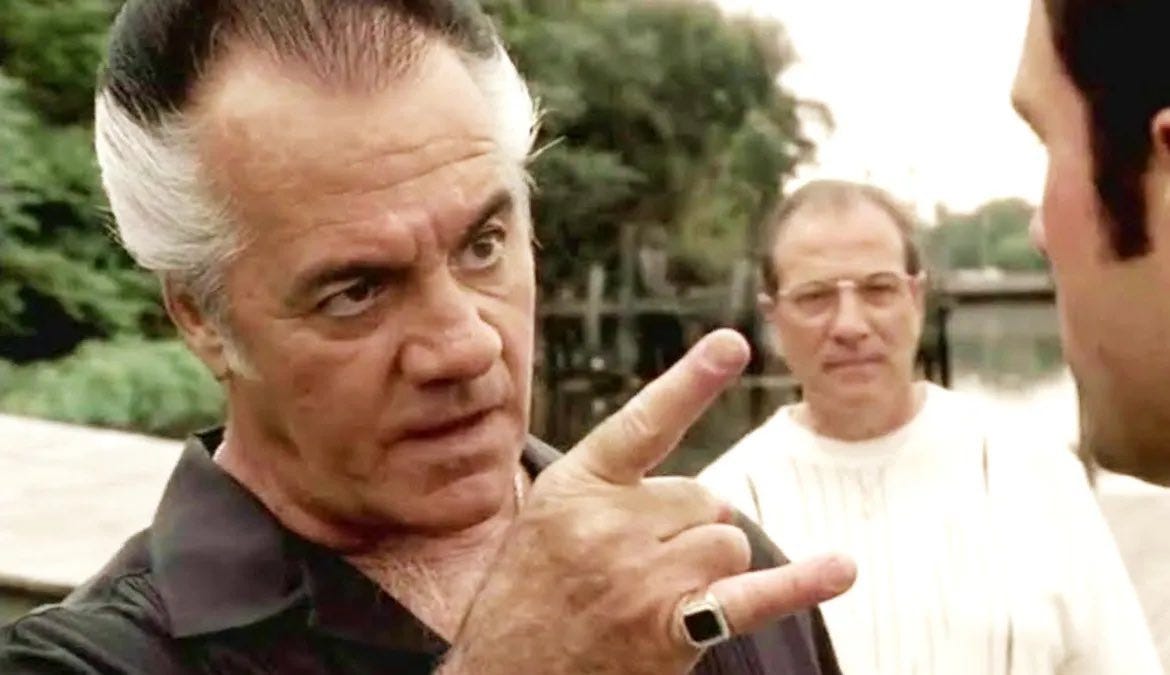
Our military is being used like Paulie Walnuts from The Sopranos, to bully other nations and make sure that the kleptocrats in Washington get their well-stuffed envelope: Don’t Call It Regime Change. This Is Something Else Entirely.7
Trump wants a few things in that envelope, chiefly access to Venezuela’s oil reserves, the largest in the world; less migration from Venezuela; and the country’s acceptance of more deportees from America. At least in the short term, he may well get them.
You could say it’s a strategy suitable for the market state era, essentially a war over supply chains and migrant flows. Not a war of conquest, and not exactly a war of plunder either, more like a war to force economic integration at gunpoint.
With the tie-in to MAGA immigration policy, one can easily how the deployment of ICE Troopers is also in line with the same Mafioso theory of lawless fear tactics. It amounts to a shameful degradation of the roles of both law enforcement and the United States military, with its long history and its reputation, in our storied past, as a force for good. Who knows if that reputation can be salvaged now.
Violating Venezuela’s sovereignty just to get a deal on favorable terms is a heinous act that is paltry in its vision. If we really want to rule our hemisphere in a recasting of the world system, it should be done in a way that is lawful - meaning actually based on establishing and following rules. Rules that are made with the consent of the people, in the spirit of freedom that is the inheritance of our nation’s founding.
But that’s obviously a task for a future administration.
I was a graduate who didn’t care for academia per se, but was loathe to leave the scene. So I lingered there in my twenties, working at the University’s Computer Center.
For a geopolitical history of oil, see: Yergin, Daniel. The Prize: The Epic Quest for Oil, Money, and Power. United Kingdom: Simon & Schuster, 1991 (ISBN 9780671757052).
The famous treatise extolling naval power is Alfred Thayer Mahan’s The Influence of Sea Power Upon History: 1660-1783, published in 1890.
This is covered in one of my favorite historical biographies: Mortimer, Ian. The Perfect King: The Life of Edward III, Father of the English Nation. United Kingdom: Penguin Random House, 2008 (ISBN 9780099527091).
This process is documented in a book which is a must-read for military history buffs: Taylor, F. L.. The Art of War in Italy, 1494-1529: The Transition From Mediaeval to Modern Warfare During the Renaissance. Leonaur Limited, 2012 (ISBN 9780857068156 ). First published in 1921.
There are 193 signatory states to the UN charter, and then a few outliers like Palestine and Taiwan that are governments but not part of the agreement. Since Taiwan will never be recognized by China as an independent state, China will likely always claim that it has every right to invade it at will without violating the UN Charter.
I tried linking to a gift article here, not sure if it will work.