
Which Way to Turn? Right? Left?
Red? Blue? Do we even know which way is up?

In this publication, I’ve repeatedly framed the current state of U.S politics as a factional conflict. Sometimes it’s even called a second civil war, or Cold Civil War II - and it’s only “cold” because it hasn’t broken out into a full-blown Alex Garland-style conflict with militias battling in the streets.1
The theory is that these factions arose out of the liberal Democrat/conservative Republican split that has long defined electoral politics in this country. At some point (around the year 2000) they got turned into colors - the Blue State versus the Red State. Many of the political positions hardened, particularly around abortion access, gun control, LGBTQ rights, and immigration. These are what you might call the flashpoints in the Culture Wars.
I’ve been tracking these partisan differences practically since 20002. As we’ve see-sawed back and forth between which faction is dominant and is implementing its particular policy regime, I’ve tried to identify some sort of values consensus or compromise that might be emerging3, something that might allow us to move past the flashpoints so we can address deeper structural issues with our economy and social welfare system. But getting to a consensus has proven elusive, and I don’t know about you but I’m still reeling from the whiplash of the latest regime change.
I mean, it seems that we do have a majority perspective, it’s just hard for it to assert itself electorally. We the people want women to have abortion access, but understand there should be restrictions based on respect for the sanctity of life. We want common sense gun control, but not to abandon the idea of an individual right to bear arms. We accept gay marriage and the rights of gays, but are warier when it comes to trans people (sorry). We favor immigration, are OK with people who immigrated illegally as young children (“dreamers”) having a path to citizenship, and absolutely oppose trampling on the rights of migrants as the ICE troopers are now doing.
But these are all 60-40 viewpoints, and given our electoral system that becomes a 50-50 split, and so our zombie government keeps shuffling along.
There’s even this idea that this is sort of by design, that these wedge issues are used by the elite class to keep us divided so that they can run the show no matter which faction is supposedly “in charge.” That’s how the 1% get to keep all the wealth and lord it over the rest of us. It’s certainly a viewpoint that fits these conspiratorial times.
Consider this recent news story, where a new feature on the social media platform X revealed that many MAGA accounts are actually based outside of the United States.
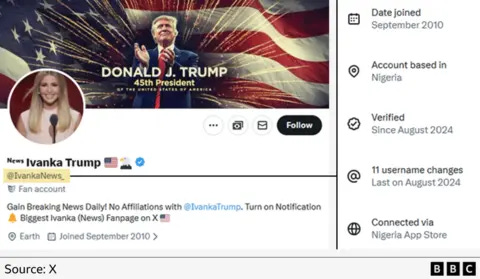
It’s a story that supports a narrative of partisan conflict being fueled by outside agitators, though I honestly don’t think it reflects a conspiracy of elites. It’s simply that there are enterprising invididuals trying to make a buck off of engagement, and open networks have presented them with an opportunity. To be fair to X, since this story broke, many of these accounts have been suspended - just click through to the BBC story and see for yourself.
I agree that there are profiteering incentives that encourage some actors to foment partisan rancor, and that this only helps the oligarchy to keep its lock on power. But the factional differences are still meaningful.
When I listened to the resignation speech recently posted by Representative Marjorie Taylor Greene (R-GA), I was struck by how often she spoke out against the “elite donor class” and in favor of “common Americans.”
Let’s just ignore the fact that she is wealthy and therefore arguably an elite, and that by “common” she might mean “white.” This famously conspiratorial, Ultra-MAGA Trump enabler clearly gets the frustration of ordinary people and their feeling of being left behind by elites. As in fact Trump himself does - that’s the whole populism angle that brought him to power.
But unlike Trump, MTG is apparently sincere (I give her that credit) and she makes plain what her partisan policy positions are - anti-abortion, pro-gun, anti-trans, anti-immigrant. She’s not going to compromise on these points. So how exactly are we supposed to become undivided and overthrow the elite donor class, if these Culture Wars issues are so important even to those who supposedly represent the ordinary American?
You see what I’m getting at, right? Representative Greene can’t really represent the “common American” if the majority of Americans have the opposite views as her on issues, such as abortion access and gun control, that have a real effect on people’s lives and can’t simply be conceded so that we can be united against the broligarchs.
That said, I do applaud Ms. Greene for her courage sticking up for sex trafficking victims in the push to release the Epstein files.
So, Will It Be Red or Blue?

Or, more to the point, what does it matter if politics in Washington remains the same, no matter which party is in power? It’s not really a choice, then, isn’t that the complaint?
As I’ve noted before, what drives the MAGA movement is a desire to reverse the clock and restore the American dream as it was defined in a bygone age, when families could survive on the earnings of one (presumably male) breadwinner. Its conservatism seeks to rein it what it perceives as the moral excesses coming out of cultural changes that have empowered women, gays, and minorities.

There is no way to take those hard won rights away that is not brutally oppressive and retrograde. So how is that conservatism, if there is nothing to conserve? MAGA seeks to create a future by returning to the past.
The opposition to MAGA, at least, wants to expand the definition of “American” to fully include women, gays, and minorities - to extend to them all the same rights and protections that originally were granted only to white men of property. To me, that is more forward looking and the clear choice.
It would probably be helpful, though, for the woke faction to get over its grievance-driven identity politics. Because so long as we keep fighting this out as a cultural issue, we will be stuck in a Future is Past whirlpool, going round and round and getting nowhere.
Meanwhile, there are pressing new issues bearing down on us, and our protracted Culture Wars have prevented us as a polity from forming any kind of coherent strategy for dealing with them.
Given that our lives have migrated so thoroughly to the digital space, how do we common Matrix-bound folk protect our digital privacy, and wrest control of our personal data from the tech oligarchy?
How do we mitigate against the harmful effects of pervasive AI technology? Not to say there are no beneficial effects, just to acknowledge that there are harmful ones and that we need to establish rules to reduce the harm. Like we’ve done with every other major transformative technology (think of how much safer cars are today then they were 100 years ago).
Similarly, how do we mitgate against the harmful effects of climate change? It’s too late to stop it, but instead of even facing the problem we are still arguing whether or not it’s a real thing, for crying out loud.
How do we redefine U.S. foreign policy in a way that is sane and aligns with humane international law, while also adjusting to a global balance of power that is shifting away from the old Cold War polarity, to a multipolarity with rising Great Powers like China and India? Or are we just going to wait for China to invade Taiwan, and then have nuclear war, like it says we’re supposed to in all the scifi apocalypse books our grandparents used to read?
If we’re going to have a better future, we have to get our bearings in this rapidly changing world, which we can’t do while locked in conflict over issues we’ve been fighting over for decades.
The key to our future isn’t going to be found in our past.
I refer of course to the film Civil War: https://en.wikipedia.org/wiki/Civil_War_(film)
For example, see this page from the early Internet: http://stevebarrera.net/bs/cult/BSRBWars.html
Here’s something I wrote early in the Biden era: https://stevebarrera.com/an-emerging-values-consensus/