
A House Divided
The vexing possibility that the partisan split in the U.S. will lead to another Civil War

When I started this publication, I introduced a meme I made showing the United States at the crossroads as it faces its Crisis moment.
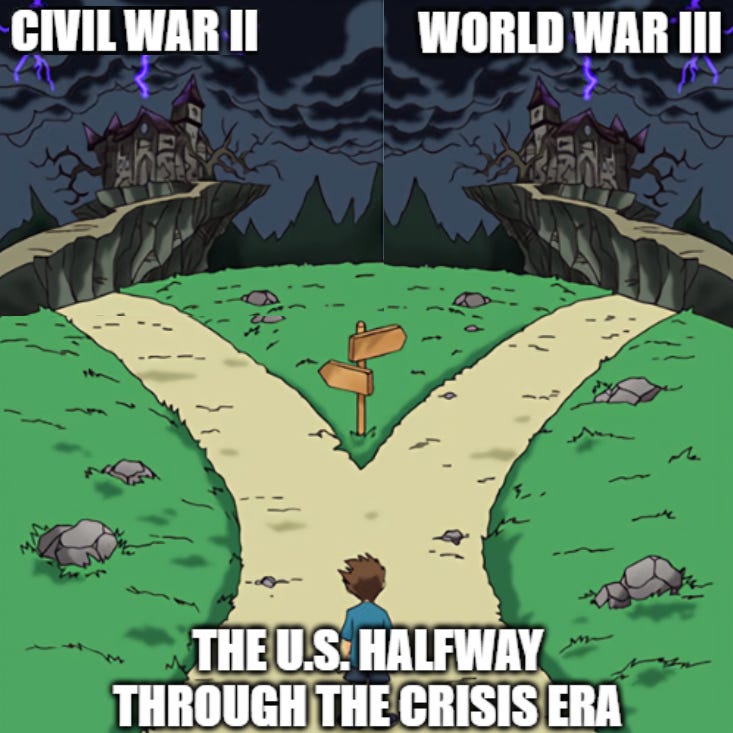
It’s a doomy meme that captures the danger of the moment, and raises the dreadful possibility of a second American Civil War. This is something that has been on the public’s mind for quite some time. You’ve surely encountered claims that we are already in Civil War II, or perhaps that we are in Cold Civil War II, which suggests that any day now it could turn Hot. Which would obviously really suck.
One of the throughlines on this publication is examining how what we are going through today resembles what we have experienced in the past, so naturally a post looking back at Civil War I is in order.
The Road to Civil War
I can see some very obvious parallels between the decade preceding Civil War I and now.
First, the country before the American Civil War was, as it is now, split into two irreconcilable camps. The issue that divided the nation then was slavery, with States partitioned between “slave” and “free” and the Federal government managing a balancing act to prevent either faction from overwhelming the other. This couldn’t be kept up indefinitely, and the tension broke when a President was elected from a party that included many fervent abolitionists. The slave States then decided to secede, and you know the rest.
Today’s camps are split by the Culture Wars, with States divided between “red” (conservative right) and “blue” (liberal left). The issues in this cultural conflict are myriad, with some in particular - gun control, abortion access, transgender rights - being where the factions draw a hard line. The Federal government, control of which seesaws back and forth between the political parties, has not been able to assert a definitive legal position on Culture Wars issues. This responsibility has devolved to the States, leading to great uncertainty for individuals living in the country.
In its current incarnation, the Federal government has initiatied an authoritarian crackdown on immigration, putting the issue of migrants’ rights front and center in the ongoing Culture Wars. A major Constitutional Crisis pivot point right now is the assimilation of the latest waves of migrants - the ones taking our country away from the majority white status that MAGA defines as “great.”
The fear that old white America is losing ground is what’s behind House Speaker Mike Johnson’s argument that immigration is only permissible when the migrants don’t “change society.”1 The countering view is that America’s promise applies to all who come here, that all who live here are afforded the rights and protections of our Constitution. The size and energy of the Resistance against the administration’s crackdown suggests another irreconcilable difference between MAGA and woke.
Second, in the 1850s, as in the late 2010s to early 2020s, the dominant national political parties fell apart, as the political party system underwent a realignment. In the 1850s, it was the Whig party and the Democratic party that disintegrated. The 1860 election featured four candidates, all of whom had a significant percentage of the popular vote, and none a majority. Lincoln, representing the upstart Republican party, won thanks to the electoral college, and became the first of a long line of Republican Presidents.
Similarly today, while the two parties that make up our system remain the same in name, they are both transforming as politics realigns, yet again. Increasingly, the Republican party is becoming the party of the working class, while the Democratic party is the party of the educated elite, reversing their previous roles. This has been an ongoing process for years, coming to a head in the past decade, as explained in this interview with GOP pollster Patrick Ruffini:

The following graph, taken from the post above, makes clear the shift in party coalitions. It also explains the Obama to Trump voter path, as Obama had a coalition closer to Trump’s than either Biden or Harris did.2
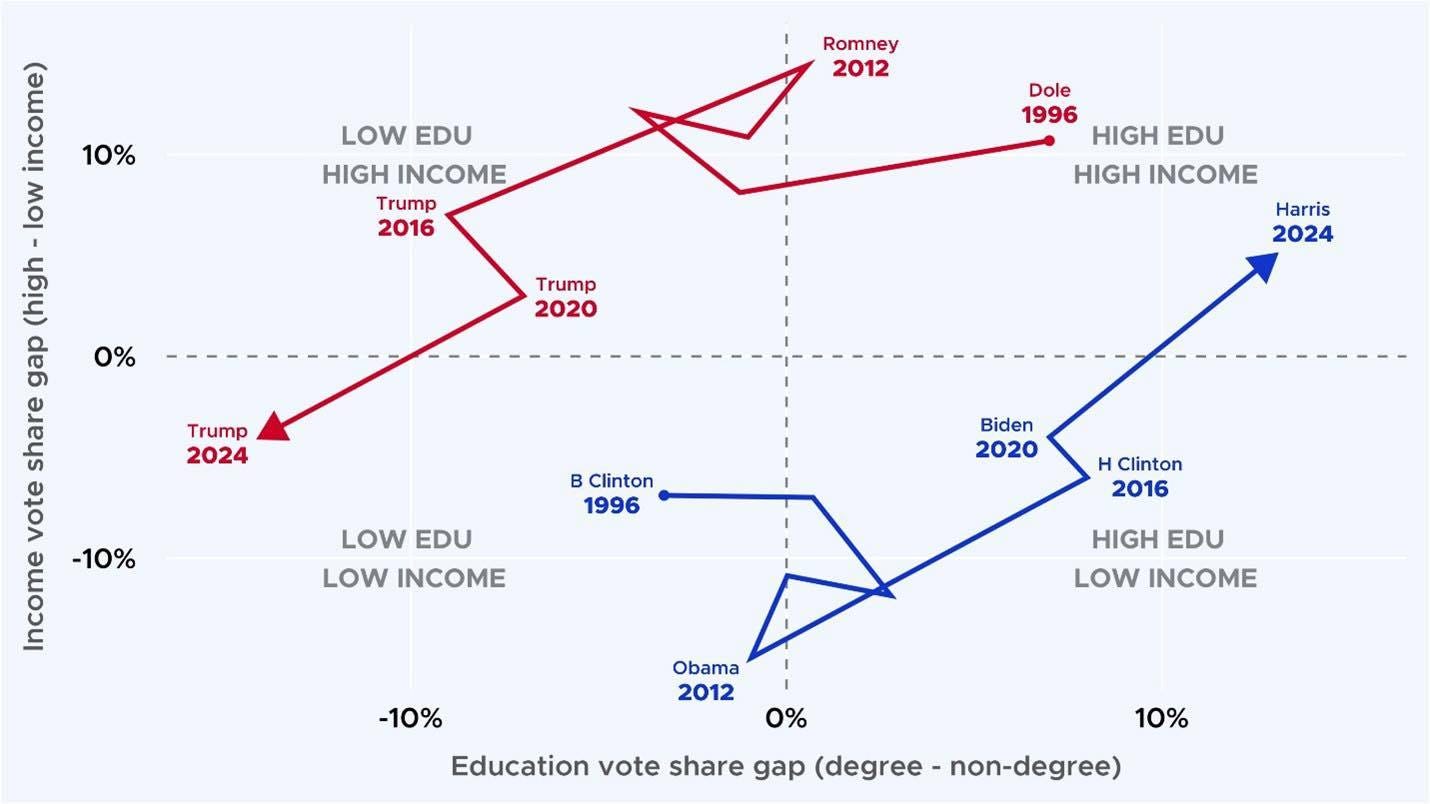
Ruffini argues that the GOP’s electoral success is due to a multiracial populist coalition. How to reconcile this idea with the party’s racist immigration policies and its service to wealthy oligarchs? Don’t these voters realize that they are being conned?
I think the answer is, yes, voters do understand the weaknesses of the Republican party. But they see the Democrats as even weaker. The populist upswell demands radical change to remake an economy seen as unfair and unworkable. The MAGA message resonates with that need better than the woke message does, even if the MAGA policies aren’t actually helping.
On the course of political realignment, the Republican Party’s transformation is complete - they have become the MAGA party, and there’s no going back. Meanwhile, the Democratic Party is struggling to find its own populist economic vision suitable for the new era. It has made some traction with the popularity of more left-leaning, socialist politicians like Bernie Sanders, Alexandria Ocasio-Cortez, and Zohran Mamdani - but they are not the mainstream leaders of the party.3
A final commonality between today and the period leading up to Civil War I is a breakdown of civility between the opposing factions - even to the point of violence. In the 1850s there was an infamous incident in Congress in which a Representative beat a Senator unconscious (yes, in the Capitol Building). There were other acts of violence involving politicians in that era, and many would go to work armed (yes, in the Capitol Building).
Today, as well, there has been an uptick in political violence in the U.S. Recent politically motivated attacks include an assault on the husband of the Speaker of the House, and the murder of a Minnesota lawmaker and her husband. In 2020 there was a plot by a militia group to kidnap the governor of Michigan. Fortunately, it was thwarted, and most of the plotters are now incarcerated. Unfortunately, politicians today must face the threat of violence as an everyday part of their job now.4
The breakdown of civility extends to broad public reaction to events, as well. I’m sure you’ve seen plenty of mean-spirited memes coming from both sides of the partisan divide. Laughing emojis on posts lamenting the treatment of migrants by ICE are particularly appalling to me - to these people really think it’s funny that helpless people are being brutalized and terrorized? I can only hope that at least some of the reactions are from programmed bots.
Lest you think I am implying that only the MAGA faction is cruel, please watch this video in which a YouTuber has compiled shots of wokesters celebrating the murder of a right-wing influencer. A cruel world, indeed. Perhaps some of the hundreds of thousands of likes she reports were from bots. But surely many or most were from real people. As she puts it, “if it’s now normal to murder people who disagree with you, we don’t have a society.”
The erosion of standards of civility and the normalization of political violence is what makes it possible to conceive that we are headed to a state of war. That is exactly what you are in when two in-groups each perceive the other as an out-group that has forfeited its legal right to life. That is the definition of war.
The American Troubles
A partisan split between two irreconcilable factions, a political party realignment, and increasing incivility - we share all of these in common today with the 1850s, the decade that led to the American Civil War. Does that mean we are going down the same path? What might be different between then and now?
An obvious difference is that the factional split in the mid 1800s was along geographic lines. The free States and the slave States formed two distinct blocs of contiguous States, separated by a continuous if not exactly well defined border. That opened up the possibility of one bloc being able defend itself militarily from the other, and thus take a chance at separation and the formation of an independent government. Thus, for a few years there, there was a United States of America and a Confederate States of America.
The Northern and Southern States in the early decades of the Republic were practically two separate societies, and it was a miracle that they had successfully formed a Federation at all after the Revolutionary War. The American Civil War could be considered a final(?) test of their ability to stay together as a Union, and passing(?) that test was a step in the country’s evolution into a true nation state.
MAGA and woke might be considered two different subcultures or subsocieties within America today, but how are they geographically separated? We speak of Red and Blue States, but really the split is more rural-urban. The Red States contain large cities whose populations lean toward Blue partisanship (for example, St. Louis, Missouri) and the Blue States have large swaths of rural land populated by Red partisans (for example, upstate New York). Where would the front lines be in a war like that?
If the current Cold Civil War were to get any Hotter, it would probably develop into what is called a low-intensity conflict, with militias fighting against government forces, and guerilla warfare - it would be a mess. Think of the fighting in Iraq during the American occupation in the 2000s. It would be ironic for history to turn the tables on us like that, and give us a taste of what we have brought to other countries.
Perhaps Hot Civil War II would resemble the war over Northern Ireland’s sovereignty that was fought in the late 1900s between paramilitary forces seeking independence from the UK, and the British army. Our own version of The Troubles.5
I don’t mean to jinx this into happening, it would be a terrible thing. The way to avoid that outcome, I think, is to eliminate the razor thin margin separating the political factions. One side or the other needs to get its shit together and capture enough of an electoral majority to enact policy with a clear mandate. That takes us to a situation more like what FDR had in the 1930s6 than what Lincoln had in the 1860s.
Conflict in the Crisis Era
My meme showing two paths for the U.S. in the Crisis Era leaves out a third path, where we have both Civil War II and World War III.7
As explained in my introductory post, this is what historian Neil Howe states in his book The Fourth Turning is Here8, and in his current writing and interviews - that the struggle we are in today could involve conflict within our society, or conflict with other societies, or both.

That is what happened in the Revolutionary War, in which there was fighting between loyalist and patriot forces at home as well as war with Great Britain (and eventually a crucial alliance with France). During the American Civil War, the Confederacy sought recognition from major powers like Britain and France, and had they acquired it, might have brought them into the war as allies. Even in the 1930s there was internal conflict, and had the Business Plot succeeded we might have ended up on the Axis side of World War II.
My point is, we can’t necessarily see internal conflict and external conflict as two separate paths. The fate of both are intertwined.
Consider this scenario: Trump invades Greenland.9 In response, the European Union and Canada sanction the United States. Canada makes overtures to join the EU, while Trump foments secessionist movements within Canada. Meanwihle, the anti-Trump Resistance in the US takes to the streets, only to be brutally repressed by Trump regime forces. As the violence intensifies, each faction within the US works closely with its allies outside the US, exchanging money, arms, and logistical support.
You see what I’m getting at? In an era in which political struggle is marked by fractured loyalties and shifting alliances, the conflict within a society and its potential conflict with other societies are inextricably connected. That is the scenario the United States faces today - as a major superpower, our troubles affect the whole world.
Just browse through today’s headlines and this will be clear.
Anything like a second American Civil War would be fought along the lines defined by today’s MAGA vs. woke partisan conflict, or more likely simply amount to a resistance war against a military crackdown instigated by the Trump administration, if that would even be possible. It probably wouldn’t resemble the first American Civil War, with its marching armies and front lines, a war that looked like any other war between distinct nation states.
We are in our own unique location in history, fated to resolve our conflict in our own unique way.
I also couldn’t help noticing that Clinton is the closest to Trump of all the other candidates (including the Republican ones), and both he and Trump are Epstein buddies. Does that mean that’s what it takes to have a winning coalition these days? A dark thought.
Michael Alexander has a Substack in which he outlines just such a framework for a new economic policy. See, for example: What is the Democrats’ problem?
Check out this article, which directly compares today’s climate of political violence with the 1850s: A Plot Against an Embattled Governor? Militias Disrupting Elections? It Happened in the 1850s—And Holds a Lesson for Today
I honestly don’t know a lot about this period, but “American Troubles” is a catchy name. Perhaps a more detailed comparison could be the subject of a future post.
Yes, I will get to a post comparing today to the 1930s, don’t worry.
I suppose there could also be a fourth option where climate change wipes out civilization, which is like leaving the path and going off a cliff, but that scenario doesn’t leave much to discuss.
Howe, Neil. The Fourth Turning Is Here: What the Seasons of History Tell Us about How and When This Crisis Will End. United States: Simon & Schuster, 2023 (ISBN 9781982173739)
I realize he TACO’d on Greenland and is now after Iran again, who can even keep up with this guy? Bear with me, I’m just spitballing here.