
Introducing "Darkest Hour"

I started this publication, like many others here, so I could weigh in about current events. I've been doing so for years already on a blog1, previously had done so on another blog back when the blogosphere was young and full of promise, and then decided to join Substack when I saw that it's where all the smart social commentary is these days. So here I am, a Gen-Xer pushing 60 years old, ready to share some of my thoughts about where we are in history.
I have long been interested in history in general, and in theories of historical cycles in particular. But I didn't want to make this publication about cycles, even though much of what I write might be informed by my understanding of past cycles and past events. Rather, it's about where we are right now, in this era, the era of my midlife, coming to an end in the not too distant future. Afterwards, in my old age, we should be in a new era.
Where do I get that from? If you know me from my blog or from elsewhere online, you know that one of my interests is generational cycles, particularly from the Strauss-Howe perspective. In their version of a cycle, we are reaching the end of a saeculum – a period of history approximating the length of a human life. As we pass from one saeculum to the next, we go through a transformation of the civic order, involving an epic power struggle.
Sound like what is happening now? It should. From this generational perspective, we are witnessing the final dissolution of an older order, one established by now mostly passed away generations. Today's living generations, born into that order but not committed to it, are creating a new one, admittedly a messy process. When the transformation is complete, there will be a sense of entering a whole new age, of passing through "the gates of history."
The last time this happened was during World War II. You may have noticed that when commentators today discuss the crumbling world order, they often refer to it as the "post-World War II" order. Similarly, when the current power struggle is over, it will make sense to speak of a new "post-whatever we call this conflict with hindsight" order for a new "post-etc." age.
"Strauss-Howe" refers to authors and researchers William Strauss and Neil Howe, who first started writing about generations and cycles in the early 1990s. Their most famous book together is undoubtedly "The Fourth Turning," published in 1997. William Strauss passed away in 2007, but Neil Howe is still writing; in fact, he is here on substack.2 In his 2023 book, "The Fourth Turning is Here," and in his current writing and interviews, he states that the struggle we are in today could involve conflict within our society, or conflict with other societies, or both.
Exactly what kind of conflict – well, we can't be exactly sure what, if anything, is in store, but we've certainly had an inkling. There are plenty of Internet memes out there anticipating either a second civil war in the U.S., or a new global war, usually involving the U.S. and China as chief antagonists. It was enough to inspire me to create a meme of my own:
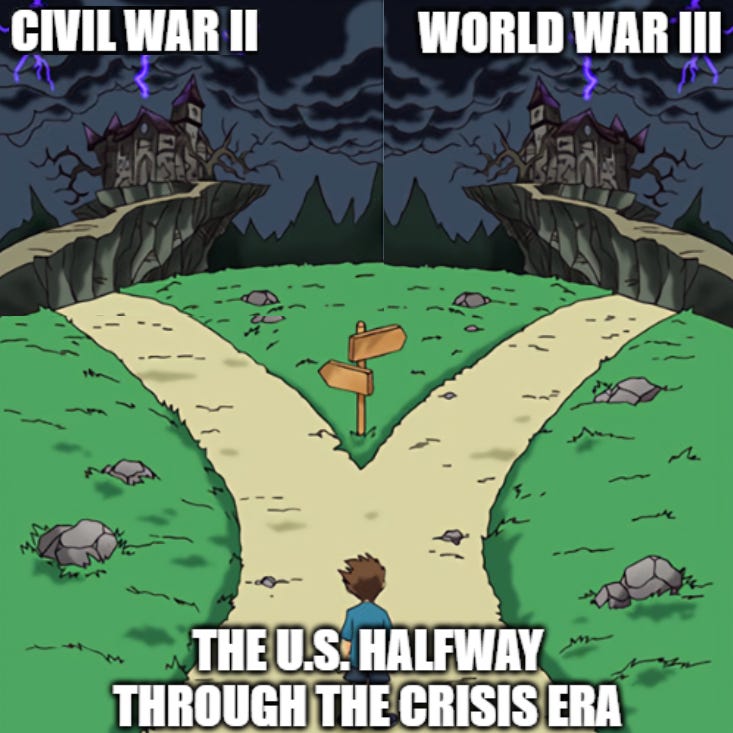
Not a very bright future depicted there, looking through the gates of history. The image captures the foreboding many of us feel, and the idea that we are facing, in the words of a former President, a rendezvous with destiny.3
When I contemplated starting this substack, I thought I might title it "America at the Crossroads" or "At The Turning Point" or something like that – in line with the imagery of this meme. But since I wanted this publication to be more about where we are than where we might be going, I decided instead on "Darkest Hour." That evokes the foreboding, the sense of doom that many of us feel today – and also a famous quote from World War II that carries some promise.4 The darkest hour, after all, is before the dawn.
My blog is here if you are interested: https://stevebarrera.com/

The quote by FDR is: “There is a mysterious cycle in human events. To some generations much is given. Of other generations much is expected. This generation of Americans has a rendezvous with destiny.” See: https://www.presidency.ucsb.edu/documents/acceptance-speech-for-the-renomination-for-the-presidency-philadelphia-pa
Winston Churchill used the phrase to describe the fall of France but it was allegedly already in common use as times were bleak for the Allies in 1940-41. See: https://en.wikipedia.org/wiki/The_Darkest_Hour
Agree with your insights Steve! Best thing I got from SnH was to stop looking at social trends linearly. To avoid projecting ever improving towards techno -paradise, or seeing everything degrade to catastrophe.
So yeah things are getting worse, and then they'll get better again, and the cycles continue.
That still leaves me wondering, and it came up in a IRL conversation yesterday, what the peaks and valleys of the cycles are. How bad will things get before they turn around? History shows us that the low points are truly deeply low.
That leaves me wondering about the on-the-ground decisions individual citizens have to make with the limited information available to them? In our world that limited information includes the problem that much of what we think we know is mis- or dis-information very unique to our world. Of course every era has their propaganda, it's just that ours includes specifically AI videos, algo-driven echo bubbles, etc.
So, how would a German-Jew in the 1930s have known they should have left Germany? How would a French Aristocrat have known they should take a trip in July of 1789? And where should either of them have gone?
I don't have answers, just more trains of thought.